Monday, July 29, 2013

Another Band Launch

Much has happened around here since we last talked.

The New Flamingo Swing Orchestra played a gig at Kuumbwa Jazz Center and thoroughly blew the roof off the place.


We've been working a saxophone quartet at Hoffman's every other Monday. with Jason Tellez on alto, Brad Hecht on tenor, and Tennessee O'Hanlon on baritone.

I just posted on Facebook:

I used to think that the way to bring the music business to its knees would be to have a band called Various Artists come out with an album called Self Titled. Come hear the latest variation on that theme, as Tennessee O'Hanlonon baritone, Bradley Hecht on tenor, Jason Tellez on alto, and yours truly on soprano/alto perform as the Bootleg Saxophone Quartet. Hoffman's on Pacific Avenue, 6:30, to be joined at 7:30 by bassist Isaiah Roberts and drummer Olaf Schiappacasse for music of the Hollywood Saxophone Quartet and others. No cover, dinner specials, full bar.

Will video tonight's gig.

More later . . .

Sunday, May 19, 2013

Musician's Wages: 1976 vs 2013

Oh boy, does this topic ever get me riled up.

Back in 1976 I worked with several bands, notably Sofrito--a salsa band we made up out of whole cloth--and Scary Lala, the guitar-based quartet consisting of leader Larry Scala, Tom Moelering on bass, and me on various saxophones. I was living by the yacht harbor in a place we rented for around $300 + utilities. When the weekly total of gig money was made, I would often have pulled in $300-400 for just 4-5 gigs, most of them recurring weekly slots at local restaurants like the New Riverside (Francis Tong!), the Crows News (2 blocks from my house), the Pacific Steamship Company by Harvey West Park, and a couple occasional places downtown like Pearl Alley and the Catalyst.

The bad news is that the $40 gig back then pays $30 now, and that's without adjusting the cost of living from that era to this. You already know what I paid for rent, and gas was still under 50 cents a gallon in 1976. Some of the places even just give the band a meal and the right to lay out the tip jar. Some of the places noted above are still in business, and usually it'll be Olaf playing them on drums. How he's managed to make the adjustments from yesterday's money to today's is a great mystery to me. He's a fine drummer, a reliable guy to have on the gig. But can you think of any other profession where the wages paid are the same or less than they were 35+ years ago?

I didn't think you could.

So what's different?

First and foremost, the owners of restaurants and clubs are operating with a different set of assumptions about musicians. There's enough squeeze on the jazz musicians from the retired set who've moved into town with no professional aspirations but a willingness to play for free. That's new. There used to be young energetic rockers who'd do it for free, and that whole scene collapsed when the club owners found their liquor sales down.

A side note: I am a musician, but I am also in charge of selling beer, wine, mixed drinks and food. I'm the guy up on the bandstand counting drinks and making sure that our crowd for the evening is spending money. If we need to, I adjust the repertoire and the "heat." I consider this to be a sacred responsibility.

Now I know it's a time of shrinking margins, and I know if the ASCAP guy comes around, the BMI guy is sure to follow with licensing fees nobody told you about when you were opening a restaurant. But, and I'm speaking to club owners everywhere here, how can you in good conscience pay less to a band of musicians that fill your bar with drinkers than you pay your lowest-rung server?

Santa Cruz was a whole different city back then, of course. In the bicentennial year, there were two (TWO!) television stations you could get if your rabbit ears were set just right, and no cable TV. There was one screen each at the Nickelodeon, the Del Mar, the Rio, and the Capitola Theatre. The trek over Highway 17 and thence to "civilization" was a lot curvier and more dangerous back then, so there there's another reason to support local bands.

And I think there were less expectations about music generally, so that whatever one found out there was just good enough. (I've got some Sofrito tapes that Steve Peterson made with a handheld cassette recorder, and they don't sound half bad. I also have sound files of the 1972 Cabrillo Jazz Ensemble which are downright frightening, the best big band I think I ever played in.)

So what are the musicians to do?

I for one am venturing into the belly of the beast and started a biweekly gig under my name at a notorious venue just to see what the deal is. All we get are the contents of the tip jar, a drink or two, and a meal for two hours with a quartet.

I'll let you know how it goes. I want to gain the perspective of the the musicians who work these gigs, the restauranteurs who supply the space for what might be a working rehearsal, and the folks who come and listen.

I've already been the latter, hearing bands whose members I know. This I know from the experience: It's an odd thing to know that the musicians putting in their dinner orders at the end of the first set are ordering their pay.

Still, it can get worse. I know that there are clubs in Los Angeles and Austin where bands are responsible for selling a set number of tickets for each gig. THEN they play. And if the door count and the bar receipts are favorable, they might get payment for their efforts.

Don't like the system? Next!!

It hasn't gotten that bad here, yet.

I have a theory that there's an invisible tollbooth at Summit Road on Highway 17 which neatly divides Santa Clara County (where there are both jobs and commerce) from Santa Cruz County (which has neither). When you go through that invisible tollbooth you take a vow of poverty, which makes those who live here convinced that, even though they may drive a 700 series BMW and live in a house worth three quarters of a million dollars, they are poor.

I think that's the real issue. A poverty of spirit prevents these sackcloth and ashes wearing simpletons from doing the right thing: You gotta pay the band.

More later.

Trader Joe's should be in Austin: a post from my 2006 blog


UPDATE, 5/19/2013: Trader Joe's has announced plans for their third Austin store, even before they cut the ribbons on the first two. There's now a store in Ft. Worth, near my son's house, which is also very close to an Aldi Mart. I now live close to the downtown Santa Cruz store (which used to be an Albertson's when I lived here before) and the Capitola TJ's I mention in the post.

========================


One of my first memories when my family moved to Laguna Beach from the steely northland was a high-pitched, rather strident owner of the Pronto Markets chain who insisted on doing his own radio commercials. That was Joe. Joe Coulombe. When 7-11 stores started popping up like mushrooms after a rain in the forest, the story is that Joe went to a hilltop overlooking the Pacific and came back with a plan. He would reshape Pronto Markets into the "anti-7-11." Instead of trying to sell lots of things, the new markets would concentrate and staples, wine and beer, and quirky gourmet items packaged with "house brand" labels. Workers would wear tropical shirts.

And so Trader Joe's was born. You've gotta love the image of the owner of these stores responding to the invasion from Texas by deciding to do something so different that the Southland Corporation just washes over him and something unique is born in the process. This is the stuff of fairy tales. Does it matter that it might be weak on details? Did it matter when Moses brought down his tablets from the mountaintop?

Years later I went north for college and Trader Joe's followed me with a pretty large store in Capitola and, eventually, like the string of missions founded by the Franciscans, a necklace of TJ's went up El Camino Real to San Francisco and beyond.

I married and moved back to southern California. Our apartment was within walking distance of a busy (and small) west LA TJ's.

They say you never miss the water 'til the well runs dry, and ten years ago I learned what that really means when I moved to Austin, Texas. Austin is a great town, and I moved here to share it with someone I deeply loved. There is a great big supermarket here called HEB that does a pretty good job of things. Whole Foods started here. Central Market was started here by HEB. The town is food obsessed. But where was Trader Joe's?

Of course, ten years ago TJ's just occupied the west and east coasts. Around that time a TJ's opened in Worcester, Mass., which is pretty clost to where I was born. But no TJ's in Texas.

I understand distribution. I used to work for a tradeshow contractor who dealt with every concievable problem of logistics. I knew warehouses had to be built, trucks needed to roll to supply these stores. Still, when a couple stores opened in New Mexico I began to think the days of my flying places with empty suitcases were about to end.

But they didn't end. Now there are TJ's stores in New Mexico, Missouri, Georgia. We're surrounded, though Alabama, Mississippi and Louisiana buffer us to the east.

But clearly there is movement on breaking into Texas. You'd think with a state as business-friendly as Texas is that there would be no problem. They might get a sweet deal on tax abatement. Everyone else seems to.

I'm thinking it's a complex set of circumstances. Besides logistics, there's the TABC, the Texas Alcoholic Beverage Control folks. Last year they famously stationed investigators with arrest powers in bars and had them arrest drinkers for drinking.

TJ's is first and foremost a liquor store. The first one I went into, when I was too young for it to matter, had an impressive wall of Scotch. Something tells me that it might not be a good match, that maybe we're waiting for a political turn in the direction of the government agency responsible (still) for making sure that grocers don't selll booze before noon on Sunday.

Meanwhile, before I go to a gig out of state (I play saxophone for a living) I plan my TJ's stop. I spent the summer on a cruise ship in the Baltic, where TJ's owners since 1979, Aldi Mart, dominate the discount wine and booze marketplace and resemble in some ways TJ's. I'm trying to get on a ship for winter that docks every ten days about 4 blocks away from the North Beach TJ's in San Francisco.

The underlying problem, though, is that we don't have a TJ's in Austin, nor anywhere else in Texas. And that, besides the anecdotal reminicences of various former Californians, is what this blog is alll about. Thanks for checking in, and let me know if you have a story to contribute.


=========================


This is a post from this summer's blog about working on a cruise ship in the Baltic. Not many folks know that TJ's is owned by a reclusive German company, reclusive in large measure because one of the owners was kidnapped in 1971. While mighty Wal-Mart gave up on the German market, the Aldi chain owns 3.5% of the marketplace in ALL of Europe.

This entry starts off with a complaint that the English panic over alleged highjack bombers had made hash out of travel, while the English Minister of This and That would come on and report that the investigators had unearthed another pint of hydrogen peroxide. We had passengers on board the ship whose luggage, detained by the crunch in Heathrow, never in their 10 days on board the Star Princess caught up with them.

Seems like an odd transition to Trader Joe's, but bear with me.

=========================================================

Well, the British have managed to get the all that unpleasant business in Lebanon off the front pages or, in the case of the cruise ship musician, the crawls of CNN international and BBC World. What they did was round up a bunch of Pakistanis who may or may not have figured out a plot to make bombs out of common household materials that could be smuggled on to planes undetected in common carry-on baggage. As a result of all the hysteria there is no carry-on baggage allowed at Heathrow, All well and good, but if this catches on it’ll make it difficult to fly back to the states with my horns and my Powerbook in tow, to say nothing of my effects, as they call all my stuff I packed for four months in the Baltic.

I don’t anticipate flying through Heathrow. but what scares me is that this might spread to Copenhagen, where I will likely depart Europe in 31 days (this having been written August 11) for JFK or Dallas if I get real lucky.

Good news, though, as we are in Warnemunde for one last time. The last time we were here I thought I’d stumbled upon a store owned by the parent company of Trader Joe's. Our Berlin tour guide pointed out a market about a mile from the ship and said that tourists from Sweden came in on ferries to stock up for parties. So I checked it out that night, only to find the store closed. I did manage to look inside the place, though and it had a very TJ's feel to it.

Of course I had my doubters.

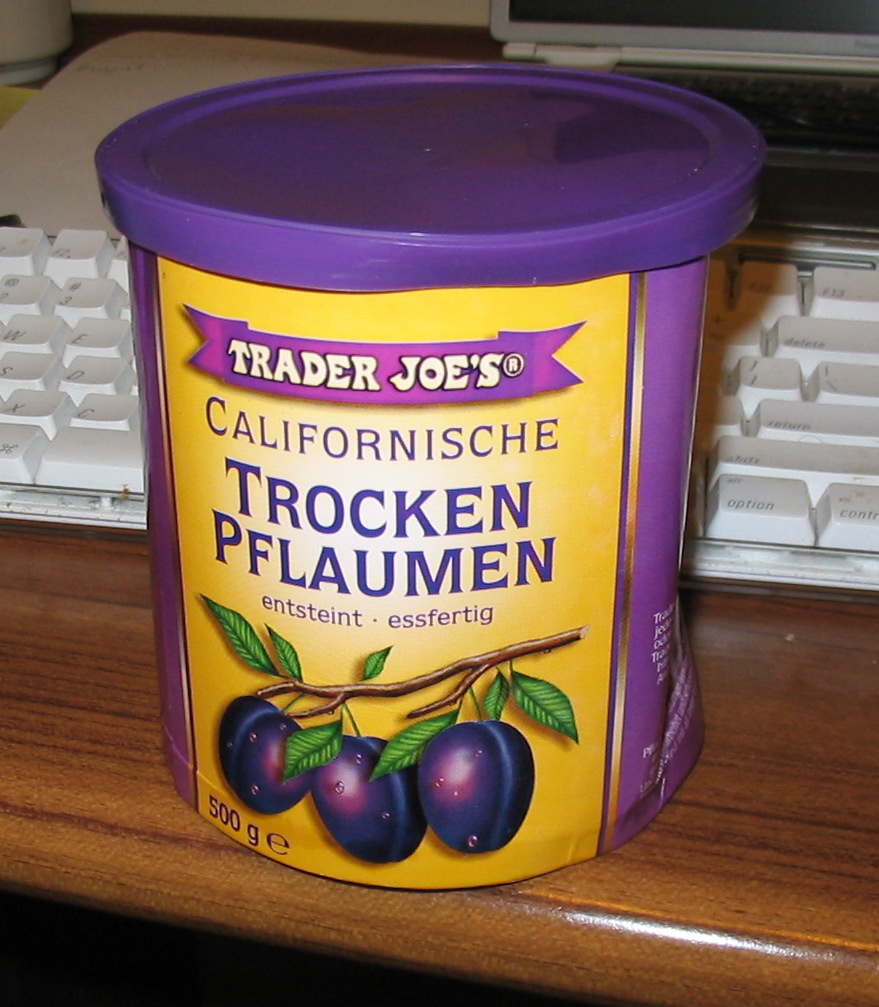
But when I got there this morning, three weeks later, I found a place very much like TJ’s. Things for sale were piled up everywhere, the booze boxes had been knifed open on one side, there were plenty of pre-wrapped cheeses and produce, and the usual assortment of sausages (Germany, remember) and frozen stuff and chocolates. I was delighted to find some Arnica gel, which I’d run out of, and which is spelled completely differently in Germany. It’s a great relief to my neck, which gets a workout holding saxophones. Still, I hadn’t found the smoking gun until, turning to the freezer case form the cereal, I found Trader Joe's branded prunes! I know that Joe doesn’t make stuff for its competition, so I did my best to ask the check-out gal if the company she worked for had any association with TJ's.

So I bought my gel, six bottles of vitamin-enhanced orange and carrot juice, Eurodont mouthwash, a chocolate bar, and those prunes--just under ten Euros. I was lax in my booze purchasing, but I felt like the Swedish passengers on the ferries deserved no competition from me. Tomorrow we start a two-day in Copenhagen. This almost felt as good as when I found a current New Yorker in Helsinki at the legendary Stockman department store. Even though it was 6.9 Euros I had to have it.

Anyway, this place is Aldi Markt. They have stores all over Germany and a certain division of their company will be opening 700 stores in the states this year. Maybe I’ll get lucky and one of the stores will be in central Texas.

Peter, wish you were here to help with the translating!

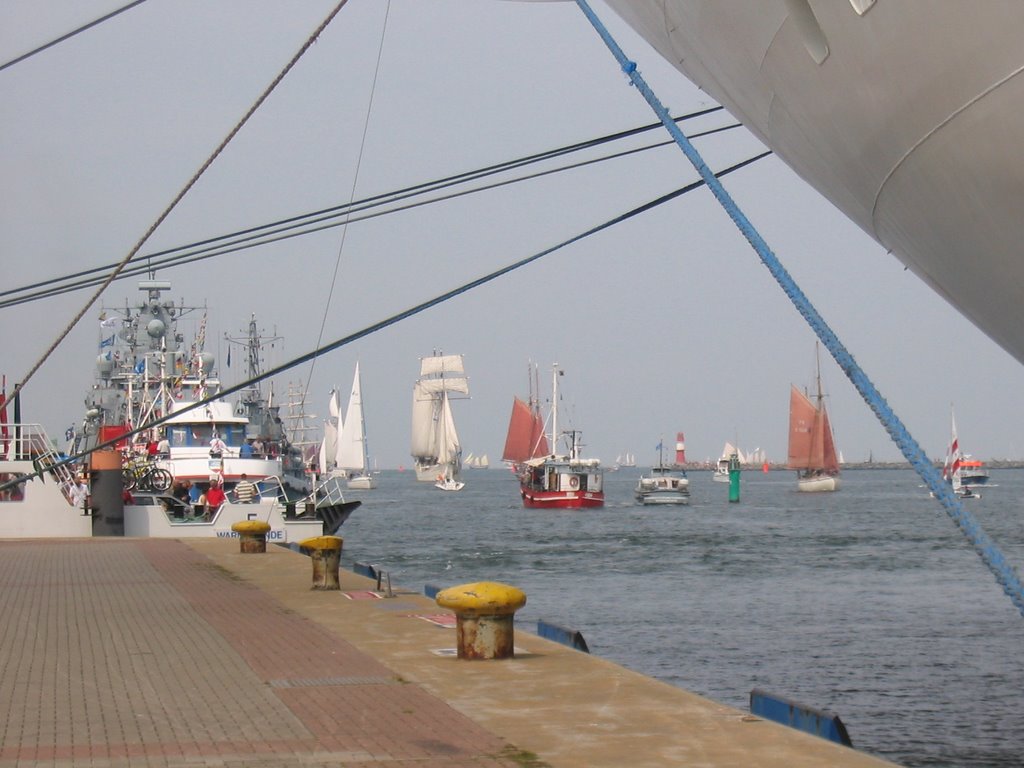
The other thing happening this day was a big sailing festival with Tall Ships everywhere. I took some shots outside the ship when I was walking around.

That’s the bow of the Star on the upper right.

Sunday, May 5, 2013

Why you should go to those class reunions


Last week I spent mostly nursing a shoulder injury. I couldn't raise my right arm to save my life, but then again what saxophone player needs that arm to rise beyond his or her belt anyway?

With that in mind, I've been less than forthcoming about last weekend, which was the weekend we were admonished by the UCSC Alumni Association to return to our "Happy Place," and hopefully drop some excess cash on the various care and feeding operations that UCSC offers.

So there we were, having lunch in the College V Dining Hall once again, and the lunch reminded me that it wasn't just my Happy Place, it was my only place.


How I dreaded that weekend! I just seemed to play the same tape of my failures over and over again, sure that I'd deposit them into a wheelbarrow and push them up the hill to the world's most beautiful college campus, where I was in the founding class on the west side of campus, just isolated enough that we back in 1969 felt in some way special. Back then just getting into UCSC was an accomplishment.

I foolishly applied to just UCSC back when I was getting my high school done. While others were welcomed by the giant bosom of such places as Cal State Fullerton, I heard only the siren call of UCSC. It proved to be a tricky process. Ernestine Anderson helped me through the minefield that was the UC system, showing me how to declare myself an emancipated minor, as my mother had gone off on an ill-fated sobriety mission with her sad husband to his ancestral home in the midwest. My test scores were enough to qualify me for a California State Scholarship, which meant I could attend any college or university in the state without a worry about paying the tuition bill. (Soon thereafter UC adopted something they called something else, but was clearly tuition. Quarterly total was $229.50.)

Now the context you have to understand all this in is this: Kids my age were needed by the Army to carry rifles in our glorious was of liberation of the Vietnamese people from their native oppressors, the Vietnamese people. The more options you had, the better.

My options were: (1) being accepted by the one UC campus that had thousands of qualified applicants at that time or (2) hotfooting it north to Canada when my draft notice arrived.

To hedge my bets, I applied as an EOP student, thinking my last name could be misinterpreted from "occupant  of the fens and bogs" to something Spanish.

Anyway, all that's ancient history, and as with so much of ancient history there's an element of twisted irony afoot, as I ultimately rejected my student deferment but my birthday was picked over #300 in the lottery in my junior year.

So I cleaned myself up and went up the hill with my invisible wheelbarrow full of failure. When I arrived, I found that everyone had their wheelbarrows, but nobody cared to talk about them.

Whew! What a relief.

There were Janet Rocklin Katz (whose perfect pitch I benefited from in Music 10), Richard Opper (on the back of whose Honda 350 I rode to the Altamont concert of destiny), Gail Harper ("no pictures please"), David Beryessa (without the overcoat), Deb Barlow (art exhibit of her dense and lively layered acrylics), and this person, Roma Sprung:


Roma was what we College V students were supposed to be back then, a bright biology student with a passion for music. And now she's the perfect example of a College V graduate, an internist who still retains her passion for music, diversifying from being a section violinist to also playing classical guitar. Her passion for music still burns within her, tempered by her role as a healer. All I've got to say to Roma, Dr. Roma, is bravo. You turned out well.

So many were absent from this special weekend that I don't wish to speculate, other than to say that the woman who came up to me at the 20th and said she had some work for me, Marjorie Baer, is no longer with us. How she figured out that I could rub some sentences together to get a result, I'll never know. I miss you, Margie.

Off to ice the shoulder.

Saturday, April 13, 2013

Vern Puntey and the School of Volvo 544


Just a little note about a chance meeting at Hoffman's restaurant downtown. That encounter was with June Hoffman, the owner, and one of my classmates at College V (Please don't call it Porter!) up at UCSC.

I introduced myself, and June immediately said that I fixed her Volvo back in the early seventies when the clutch cable snapped.

I was surprised, because most of the people in my class whom I run into remember me playing the saxophone, but there was a time when I fixed cars for pin money. In my junior year I was shuttling four Volvo 544s in and out of the west side R lot in various states of restoration, and never on my schedule. June's Volvo may not have been a 544, but there was a lot I had to learn, and the Volvo 544 was the perfect way to learn it.

There was one other element in my education that was indispensable, and that was Putney & Perry, the former Rambler dealership in downtown Santa Cruz that switched over to foreign car parts and repairs. The two partners, Vern Putney and Manuel Perry, were perfect foils for each other. Manuel took care of the business end of things, and Vern flexed his considerable knowledge about foreign cars from the counter.

I'm quite sure that whatever parts I bought were bought at Putney & Perry. I probably sent June down to buy the cable, although I can't remember the details.

What I do remember is that when I bought a Citroen DS-21 from an ad in the Buy and Sell Press, my first stop was Vern's counter (where Bob Deasy at the time was the assistant brain) to discuss why this car, with its overwrought hydraulic suspension and underpowered engine, was being abandoned by its owner because he couldn't find a mechanic who could fix the darn thing. What followed my inquiry was a thirty-minute masterclass in French car designs and their application. To me, the shadetree mechanic with a small toolbox of Craftsmans I picked up one at a time at Sears. I did get the thing running, thanks for asking, but it was stolen from a San Jose parking lot.

When Vern had a heart attack in the late seventies, the Sentinel saw fit to put the news on the front page of the daily paper, so great was the city's affection and dependency on this man and his talents.

Sadly, it looks like Putney & Perry, which was sold long ago to successors in name only (judging by their Yelp listings) appears to be closed. There's a For Sale sign out front, even though the windows still announce discounts for UCSC students, like June Hoffman and me.

Friday, April 12, 2013

The Young and the Talented: A Cautionary Tale

Let's call him Young Al.

He's an immensely talented 18-year-old who plays bass. That much is not in question. I'd played with him a few times, and when I booked a gig for which the piano player's left hand would not have been sufficient, I asked him, on the spur of the moment at one of Stella's soireés if he would be available. He was.

So a couple weeks go by, and we are informally playing tunes at Stella's to fill the requirements of the client, whose 40th birthday party we are playing in Morgan Hill (on Easy Street!) Saturday, the 13th of April.

Each and every time, the piano player, who has the most contact with Al, lets him know by text that we are having a get-together and each time he bows out.

The other day a couple things happened. First, I heard that he'd need a ride. That in itself is not a big deal, but adding an acoustic bass to the equation and you're dealing, in this case, with a ride for two people. The piano player would be taking Al, I'd be taking his bass. Shrug. Not a really big thing. But then Al decides to call me from his parents' landline, which shows up as an unlisted number on my phone. I'm on my way out the door anyway, and decide to let it drop to voicemail.

Last night I get home from playing, for the first time in quite a while with David O'Connor, who I played in Sofrito with. I had such a great time revisiting the old Sofrito book with David, Tom Brown, Alice and Steve Peterson, and Sammy the African conga player, that I decide to have a look at Facebook, perhaps post how great playing with O'C was.

When Facebook came up, there was a post from Young Al.

He was complaining that he didn't know where the gig was (he got the town wrong). He said it was going to be the weirdest gig ever.

Now I know what being a young and gifted player is like. I was pretty cocksure myself at eighteen. But I also know that posts of this sort accomplishes exactly nothing for the poster, and serves to piss off the leader, who can only guess at the vague language what the meaning of the post is, and hope like hell that the client won't see their 40th birthday tarred with a "weirdest gig ever" brush.

This morning I called him on it. I let him know in a text that he ought to have thought twice before using Facebook for these thoughts. He came back at me saying he'd run out of cell minutes, was forced to call on his folks' phone, blah, blah. Everything except the issue I was carefully focusing on.

So I let the kid go.

Lucky for me, Chris had been standing in for Young Al over at Stella's and he was happy to accept my offer.

When I was 18 we couldn't express opinions like that. Not that we had Facebook back in 1969, but the merest whisper of discontent among the sidemen, and we were out. No leader wants the client or the rest of the band having to face this sort of thing. I don't see how anything's changed.

I did the right thing.

Tuesday, April 9, 2013

Last Roundup at the Catalyst

Tonight may have been my last night playing music at the Catalyst. No, the venerable Santa Cruz institution is not closing its doors, although you'd wonder how they keep them open with the underutilized space, especially on the weeknights.

My history with this place goes back a long way, to the year I came to town. I had hitched a ride up here from Orange County on my way into the newly-opening College V dorms with a load of stuff, when the guy who gave me the ride asked me if I'd like to stop for a cup of coffee at the Catalyst. This was not the same Catalyst we know now, but the garden dinging room of the St. George Hotel that had been converted into a bohemian hangout. The St. George was on Pacific, but the Catalyst with its indoor, fern-covered fountain chugging away faced Front St.

That cup of coffee was the first one I'd ever really enjoyed in my life. It was a bottomless beige mug of pure pleasure. I don't know—maybe it was the beans or the roast or the way the drip was made, but there was something very substantial to the Catalyst's coffee.

A couple months into my College V experience got an unexpected phone call from Nick Robertson, who was in my jazz workshop class. He said he had a gig for me the following Saturday if I could make a rehearsal in Capitola. Not having explored the territory, I didn't know where Capitola was, but Nick offered to pick me up on campus and haul me to the rehearsal. I guess I did all right, because I played the gig on Saturday. The band was Dave Molinari, a piano player who taught at Soquel High School, his brother Jim Molinari on bass, Dan Sabanovitch on drums, Nick on vibes, a short tenor player whose name I can't remember, and me on alto.

I knew most of the tunes, which was a stroke of luck, because in 1969 making a tape to practice from was akin in its complexity to brain surgery. Fact was, I had most of the records which the repertoire was dawn from in my vinyl collection, which I'd schlepped up from Orange County to room B411 in the College V dorms. I can't remember exactly the tunes we played, but I know we played Tom Thumb and Footprints by Wayne Shorter. I do remember I wrote down some melodies on manuscript paper at the rehearsal, which served me well at the gig.

I remember the stage being small, and crowded with musicians and their equipment. Putting vibes in a band is not a trivial matter, and I suppose that Dave played a Fender Rhodes, because that's what you did in 1969. I was on stage right, and on my right  were the windows that opened to Front Street, next to the tenor player and Dave, the bandleader/pianist.

When we started playing, most of the packed house got into it, settling down to a quiet roar. I recall that they were all hairy, for after all this was the sixties and the counterculture was in full bloom. At that time, there was no cable TV in Santa Cruz, and with three over-the-air stations coming from Salinas and Monterey, the at-home entertainment options were limited, so naturally folks went out a lot more than they do now.

I remember the rough but fair owner of the Catalyst, a constant presence day and night at the club, which began life as a co-op occupying the Redwood Room–where the fountain was–and moving gradually into the former ballroom of the St. George, which served in the early history of the Catalyst as a storage area for paperwork for the nearby County Bank of Santa Cruz. Randall came up to the stage and let Dave know it when he thought the decibels were creeping up. Adjustments were made.


Most of all that night, I remember a gal sliding past the stage and smiling up at me named Jan Gillespie, who would leave UCSC in December of 1969, but never leave my heart.


Seven years later finds the Catalyst in new digs on Pacific Avenue. It finds me back from being on the road with Stan Kenton's band, back in Santa Cruz collecting unemployment insurance.

I am invited to the Catalyst for Friday Happy Hour with the Abalone Stompers. Jake Stock was a legendary clarinetist from Monterey who famously had two sets of false teeth, one for speaking and one for playing the clarinet. The pair not in use were in a glass of clear fluid which may well have been water next to his clarinet case.

Jake was a kind soul with a mean streak, but I mostly dealt with his son Jackson, one of the best trombone players I know, who taught me the repertoire of Dixieland music by gesture and gentle prodding. It's served me well over the years.

This is a picture of me at the old bowling alley we oldtimers will always choose to call the new Catalyst. Jake and Jackson had a gig elsewhere.


From the top left we have an unknown banjo player, Bill on guitar (who was the president of the local of the American Federation of Musicians and was here playing from the beginning of the Happy Hour gig regardless of being paid out of a tip jar, which Jake had a volunteer pretty girl circulate with protestations that we needed "a new roof on the church"), an unknown drummer, Daryl O'Day on tuba, front row is me, an unknown clarinet player, cornetist Lewis Keizer (still active in the 10th Avenue Band), and a guy named Moe who played trombone.

These were the good old days, around 1976. The crowds were into Dixieland as an accompaniment to the mating ritual provided by the Catalyst every Friday from 4 to 7. Then, sufficiently beered up, they'd go out to one of the two Mexican places on Pacific Avenue for something with tequila in it and a plate of enchiladas.

It was one of those Happy Hours that, in the recombining of the strands of life, I would for the first time go out for a plate of enchiladas with the women who is the mother of my children. Around the same time decide I wasn't good enough for the attention that a certain icy wise-mouth blonde was offering me, leading to all sorts of complications down the road three decades.

In that Bicentennial year, Randall was still prowling the premises with a dish towel, making sure that none of his customers had a dry glass, his employees weren't ripping him off, and the band didn't exceed his decidedly unscientific method of determining sonic excess on the part of the musicians. (There was a double standard at work here. In the Atrium, an open, boomy room, the musicians had to keep to down so that the customers could talk to each other. In the back room, where I played with Sofrito several times, the sky was literally the limit on loudness.)

Cut to the last couple years.


This is a view of the same area where we used to play Friday Dixieland on a Monday night when we had a Jazz Jam at the Atrium. The only identifiable constant is the staircase, visible through the door that wasn't there in 1976. The picture is from winter 2012, and the jam is in full swing. The room isn't what you'd call welcoming, and when people looked through the door they'd often turn tail.

Why? The Catalyst has changed hands with Randall's demise. The new owners are not identified, don't show up to keep track of how things are going, to supervise and make sure their employees aren't ripping them off. Nonetheless, saxophone player extraordinaire Kurt Stockdale booked us for Monday night jam sessions that start upstairs and gradually move into the Atrium, now with a permanent stage across the room from where we used to play Dixieland.


You can't buy a mug of that Catalyst coffee anymore, because the kitchen's been leased to an outfit that sells pizza by the slice to mostly homeless people out a window onto Pacific Avenue.

There's a dark deli counter where they used to sell the best sandwiches in town.

Behind the stage is a fancy fresco of the Bar at the Folies Bergere. But the bar is closed while we play, and, eventually, an ominous black curtain is pulled on the work.


The club does nothing to support our efforts, and does not pay the musicians. We get drink tickets, for which, for all I know, we'll be receiving a 1099 come tax time. Their website says nothing about the Jazz Jam on Monday nights for two years. We are seldom in their marquee. If you're one of the few people who show up, you're met with a dark, and, most seasons, cold room with a closed bar and no waitstaff. If you want a drink, you climb to the upstairs bar and get your own. Forom time to time, they rent the place out to promoters of Young People's Music. Sometimes they tell us, more often we show up and find a crowd of Rastafai have taken over the room.

It was a noble experiment, but it's done. Tiring of our red-haired stepchild status, Kurt's session moves next Monday, April 15, 2013, to the Reef on Union St.

Goodbye, Catalyst. At the important junctures of my adult life, you were there for me.

Thanks, Randall, wherever you are. Listen, the music is not too loud.